The Architecture of Structured Living
Updated: Jun 15

Start Here:
A home may look organized in photos but still feel difficult to live in.
That usually happens when the space is arranged around how things should look instead of how people actually move.
Daily life has patterns: where bags land, where shoes come off, where laundry stalls, where groceries pile up, and where people naturally pause.
Ask Yourself These Questions:
Where do things most often get dropped, delayed, or forgotten?
Which spaces create bottlenecks during busy parts of the day?
Do the items I use most often live near the places I use them?
Are my systems built around real movement or ideal behavior?
What path do I repeat every day that could be made easier?
The architecture of everyday movement is about noticing the flow of real life.
When systems are placed where movement already happens, routines become easier to maintain.
Instead of forcing people to behave perfectly, the home begins supporting the way they naturally live.
Modern life is saturated with interruption.
Notifications compete for attention from the moment the day begins. Products are replaced before they wear out. Trends cycle so quickly that environments rarely have time to settle before another wave of consumption arrives. Spaces become layered with visual noise, fragmented routines, and objects that solve temporary desires without supporting long-term function.
Over time, this constant accumulation creates more than physical clutter. It creates cognitive friction.
Structured living emerges as a response to that friction.
At Palermo Lane, structured living is not defined by minimalism, aesthetic uniformity, or rigid self-discipline. It is the intentional shaping of environments, systems, and routines so that daily life feels clearer, steadier, and more aligned over time.
It is architecture applied to everyday living.
Not architecture solely in the structural sense, but in the way environments influence movement, behavior, clarity, and emotional steadiness. Structured living recognizes that spaces are never neutral. Every environment either reinforces calm or contributes to friction. Every system either supports consistency or increases exhaustion.
The goal is not perfection.
The goal is alignment.
Why Modern Environments Create Friction
Most environments are not intentionally designed. They evolve reactively.
A storage container is added when clutter becomes overwhelming. Furniture is purchased to fill visual emptiness rather than support movement or proportion. Organization systems are layered inconsistently over time. Decorative trends accumulate without structural cohesion.
Eventually, the environment begins demanding attention instead of supporting it.
This friction appears in small ways:
searching repeatedly for misplaced items
reorganizing the same spaces over and over
replacing low-quality products prematurely
adjusting rooms that never feel settled
experiencing visual overstimulation without recognizing its source
Individually, these moments feel insignificant.
Collectively, they shape the emotional rhythm of daily life.
Structured living begins by recognizing that repeated environmental friction quietly drains attention, energy, and clarity over time.
Structure Is Not Restriction
One of the most common misunderstandings about structured living is the assumption that structure removes comfort, personality, or warmth.
In reality, thoughtful structure creates freedom.
When systems are predictable, less energy is spent managing routine tasks. When environments are cohesive, the mind processes them more efficiently. When objects have intentional placement, movement becomes easier and less disruptive.
Structure reduces unnecessary decision-making.
It removes repeated adjustments.
It creates steadiness.
This does not mean every environment must appear sparse or sterile. Structured living is not about removing meaningful objects or eliminating character. It is about ensuring that environments function cohesively rather than reactively.
A well-structured kitchen does not simply look organized. It supports meal preparation intuitively.
A recovery space does not merely contain equipment. It encourages consistent restorative practice.
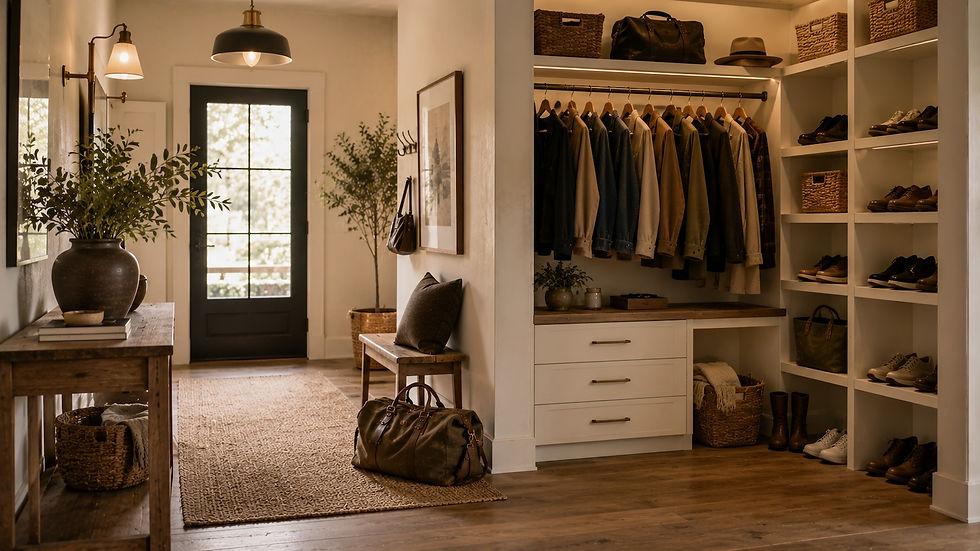
An entryway does not only store belongings. It reduces transition chaos at the beginning and end of the day.
Structure succeeds when it quietly supports life without constantly demanding attention.
The Relationship Between Environment and Clarity
Physical environments shape mental experience more deeply than many people realize.
Visual fragmentation increases cognitive load. Excessive variation forces the brain to continually process new information. Inconsistent systems require repeated recalibration.
Clutter introduces unresolved visual tasks that quietly compete for attention.
Calm environments are not calm solely because they are attractive.
They are calm because they are predictable.
Predictability allows the nervous system to relax. Movement becomes intuitive. Objects remain accessible. Spaces feel stable rather than reactive.
This is why thoughtfully designed environments often feel emotionally different even when the observer cannot immediately identify why.
The experience is structural.
Lighting rhythm, material consistency, spatial proportion, and environmental flow all contribute to how a space is processed psychologically.
Structured living recognizes that clarity is not created through motivation alone. It is reinforced environmentally.
Material Integrity and Long-Term Stability
Modern consumption encourages replacement.
Structured living encourages continuity.
Many products are now designed around aesthetic novelty rather than long-term integration. Materials deteriorate quickly. Finishes age poorly. Components fail prematurely. Spaces become layered with temporary solutions that gradually erode cohesion.
At Palermo Lane, material integrity matters because materials influence stability.
Solid wood develops character over time rather than appearing damaged. Metal hardware retains structural presence. Stone, linen, leather, and glass age predictably and integrate across multiple design evolutions.
Durable materials reduce both physical and cognitive maintenance.
They eliminate the constant reset cycle created by trend-driven consumption.
Structured living favors environments that settle and mature over time rather than requiring continual reinvention.
Systems Shape Behavior
One of the most overlooked realities of daily life is that behavior is heavily influenced by environment.
People often attempt to improve routines through discipline alone while ignoring the systems surrounding those routines.
But systems shape consistency.
A visible pantry system encourages healthier meal preparation.
A thoughtfully designed recovery space increases the likelihood of mobility and restorative practice.
Integrated pet systems reduce household disruption and support routine maintenance.
Dedicated travel organization simplifies preparation and reduces friction before departure.
When environments support behavior naturally, consistency requires less effort.
Structured living is not about constant self-control.
It is about designing environments that reinforce the behaviors and rhythms already valued.
Structured Living Across the Palermo Lane Collective
The Palermo Lane collective was built around the philosophy that structured living extends across every dimension of daily life.
We approach wellness, organization, recreation, interiors, travel, gathering, and restorative living not as isolated categories, but as interconnected systems that shape how daily life feels over time.e approach wellness, organization, recreation, interiors, travel, gathering, and restorative living not as isolated categories, but as interconnected systems that shape how daily life feels over time.
Each divisional site supports a distinct layer of modern living while remaining connected through the same foundational principles:
intentional design
material integrity
environmental cohesion
long-term functionality
reduced friction
We approach wellness, organization, recreation, interiors, travel, gathering, and restorative living not as isolated categories, but as interconnected systems that shape how daily life feels over time.
Ashford Terrace extends structured living into exterior environments through architectural outdoor spaces, refined gathering systems, layered lighting, and durable entertaining infrastructure.
Cashmere Calm supports restorative ritual through layered skincare systems, sensory environments, and immersive wellness routines that encourage consistency and recovery.
Caspian Journey focuses on structured travel systems, refined mobility organization, and durable travel infrastructure designed to reduce friction before, during, and after movement.
Copperpeak Kitchen approaches the kitchen as one of the most important operational environments within the home, emphasizing material integrity, workflow efficiency, and long-term culinary systems.
Greyson Field explores elevated recreational systems, transport organization, and field-ready environments through a refined and structured lens.
Lynden Essentials emphasizes refined daily carry systems, organization, and practical utility designed to simplify movement through everyday life without visual clutter or excess complication.
Mercer Estate integrates pet living into the architecture of the home through structured feeding systems, furniture-grade containment, and cohesive interior integration.
Northlume Living reinforces domestic clarity through modular organization systems and environmental structure designed to reduce visual and operational friction.
Oakleaf Table focuses on intentional hosting, layered table environments, and refined gathering rituals that create warmth without excess.
Velorian Studio focuses on disciplined performance, mobility, and recovery infrastructure designed to support long-term physical resilience rather than trend-driven fitness culture.
Each division reinforces the same central belief:well-designed systems create steadier living.
Structured environments are not built through isolated purchases alone. They emerge through cohesive layers of organization, wellness, material integrity, movement, restoration, and intentional daily function working together over time.
Calm Is Built Slowly
Structured living rarely transforms environments overnight.
It develops incrementally.
One organized entryway reduces daily transition stress.
One cohesive lighting system changes the emotional rhythm of a room.
One durable kitchen system simplifies routine meal preparation.
One refined recovery space encourages greater consistency.
Over time, these layered adjustments compound.
The result is not dramatic perfection.
It is quiet stability.
And quiet stability changes how daily life feels.
Designing for Longevity Instead of Novelty
Trend cycles prioritize immediacy.
Structured living prioritizes endurance.
Before introducing new systems, materials, or products into an environment, a different set of questions becomes important:
Will this remain functional years from now?
Does it integrate cohesively with existing systems?
Will this reduce friction or create additional maintenance?
Does this support the way daily life is actually lived?
These questions shift consumption away from impulse and toward curation.
The goal is not deprivation.
The goal is intentionality.
Environments built intentionally require fewer corrections over time because they are designed around function, proportion, and long-term alignment rather than short-term stimulation.
Final Thoughts: The Palermo Lane Perspective
At Palermo Lane, structured living is not viewed as a design trend.
It is a framework for creating steadier environments and more intentional routines in a culture increasingly defined by fragmentation and excess stimulation.
Structure is not about rigidity.
It is about reducing unnecessary friction so that energy can be directed toward more meaningful experiences.
A calm environment does not happen accidentally.
A cohesive home does not emerge through accumulation alone.
Clarity is built through systems.Calm is reinforced through structure.And over time, intentional environments quietly reshape the experience of daily life.